Subterranean termite soil barrier defense establishes a continuous, undetectable chemical boundary directly between the sub-grade earth and a building's load-bearing foundation. In San Francisco County, properties face…
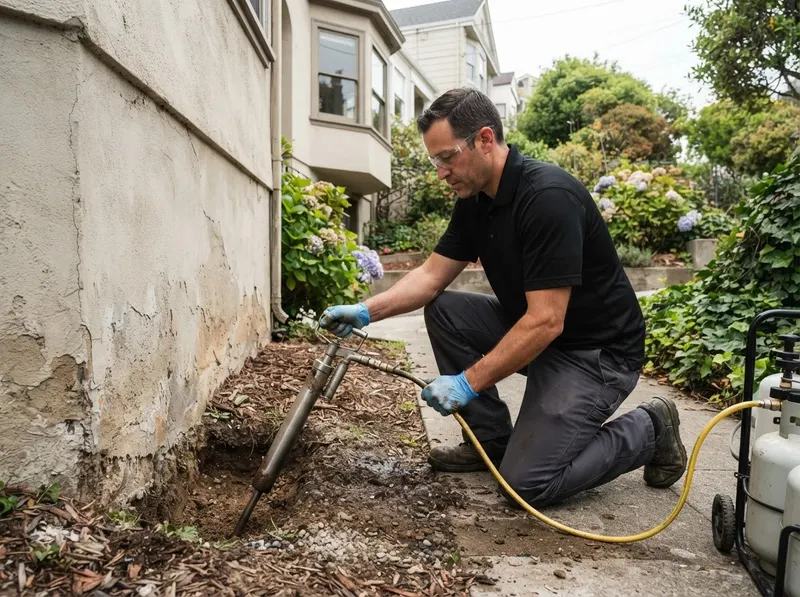
Subterranean termite soil barrier defense establishes a continuous, undetectable chemical boundary directly between the sub-grade earth and a building's load-bearing foundation. In San Francisco County, properties face pressure primarily from the Western subterranean termite (*Reticulitermes hesperus*), an organism that requires continuous soil contact to maintain critical internal moisture. Unlike drywood termites that reside entirely within dry framing, subterranean colonies build subterranean superhighways and earthen shelter tubes across concrete stems, brick piers, and utility penetrations to reach subfloors and sill plates. In row-style Edwardian and Victorian architecture throughout the Mission District, Pacific Heights, and Noe Valley, adjoined zero-lot-line configurations complicate detection because ground moisture travels across shared party walls and concealed crawlspaces.
Treatment execution requires precise physical and chemical intervention. For unpaved perimeter soil, technicians excavate a continuous trench measuring 6 inches wide by 6 inches deep directly adjacent to the foundation wall, dispensing 4 gallons of diluted non-repellent termiticide per 10 linear feet. For hardscaped boundaries prevalent in SoMa, North Beach, and the Marina District, concrete slabs, basements, and driveways are vertically drilled at 12-inch intervals using a 0.5-inch masonry bit to access the sub-slab soil bed directly beneath the pour. Injecting termiticides like fipronil under 25 to 30 PSI saturates the soil zone where termites forge entrance tubes. Because modern chemistries are non-repellent, foraging worker termites pass through the treated zone undetected, transferring the active ingredient back to the central subterranean colony through mutual grooming (trophallaxis), which collapses the entire queen-bearing structure.
Selecting a liquid barrier treatment over structural fumigation or exterior bait stations depends strictly on property access and termite species identification. Fumigation (tenting) fills interior volumes with gas to eliminate species confined to wood, but it leaves zero chemical residual in the dirt; subterranean termites simply retreat beneath the slab into damp soil and return within weeks. Soil baiting stations monitor exterior perimeters, yet in tightly packed neighborhoods like the Sunset District, Richmond District, and Bernal Heights, paved lot lines frequently leave no bare earth for monitoring cartridges. A pressurized liquid soil barrier directly addresses ground-to-frame contact zones, providing immediate structural cutoff with residual protection documented between 5 to 10 years without requiring continuous indoor disruption or ongoing monthly maintenance contracts.
Every job gets a firm, written price after a free on-site visit.
Tell us about your subterranean termite soil barrier defense job in San Francisco and we'll send a clear, written quote, usually the same day.
 Kelvex Extermination